Politics
‘Waste to opportunity’: Saskatchewan government to expand bioenergy in north

View image in full screen
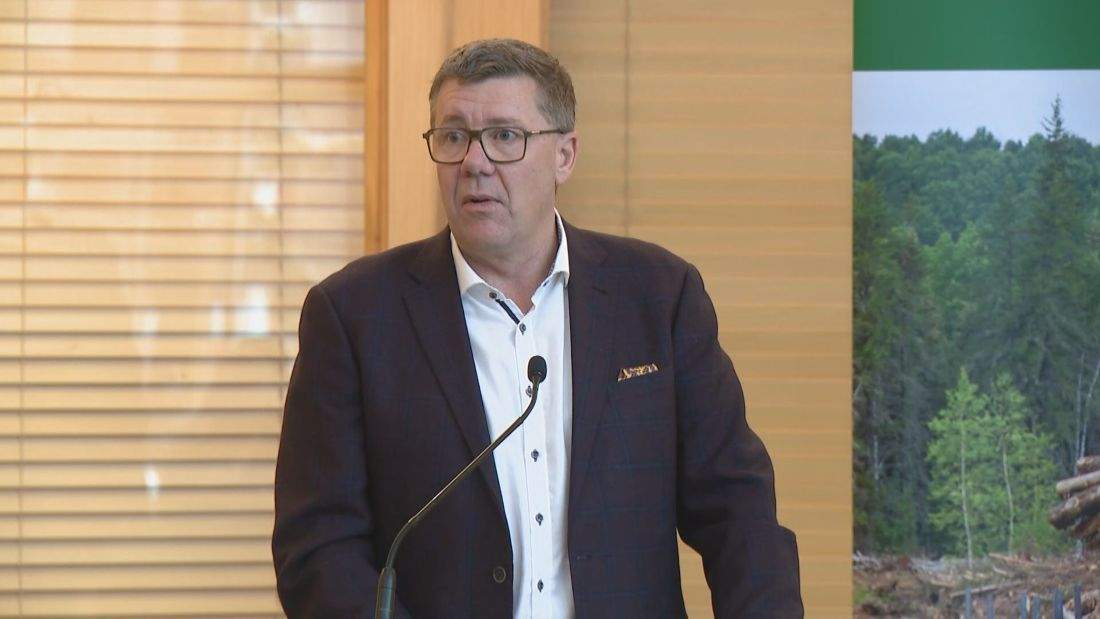
Saskatchewan Premier Scott Moe spoke with reporters about bioenergy in Prince Albert on Friday.
Global News
The Saskatchewan government is looking to expand its generation of biofuel-sourced electricity to support a growing electrical grid.

The province committed to assessing the potential for additional bioenergy power generation Friday, a move Premier Scott Moe said builds upon an existing agreement between the Meadow Lake Tribal Council (MLTC) and a provincial Crown corporation.
The MLTC Bioenergy Centre produces enough carbon-neutral power for approximately 7,000 houses and sells that electricity to SaskPower, according to a Saskatchewan government news release.
“Electricity demand is projected to increase by 40 per cent by 2035, and that number can move significantly one way or the other. And (it is) expected to more than double by the year 2050. That’s significant growth,” Moe said at a news conference in Prince Albert.
“Meeting that demand will require Saskatchewan to continue to consider every available option.”
The project will max out at 100 megawatts of electricity production. Moe said that amount supports Saskatchewan’s growing electrical needs and forestry sector.

Get breaking National news
“Today is about opportunities for future partnerships by taking an agreement that is working in this province with Meadow Lake Tribal Council and making it available to other communities across the province,” he added.
Bioenergy is produced with waste known as biomass, including forestry residue, agricultural residue and processing byproducts, according to the Natural Resources Canada website.
To produce energy, those products are broken down into combustible synthetic gas, that gas is then cleaned, conditioned and prepared until it has the chemical makeup required to produce energy.
“It turns our forestry and agricultural byproducts into a very valuable resource generating power for our families and for our jobs,” Moe told reporters.
Bioenergy can be renewable, though Natural Resources Canada notes that whether it falls under that umbrella depends on the rate of regeneration in relation to the rate of consumption.
- N.B. government in talks with Quebec firm about restarting idled Nackawic pulp mill
- Quebec pledges to unveil a road map for phasing out fossil fuels
- Warning of credit rating downgrade ‘not a hinge moment’: Ontario finance minister
- Lorne Doerkson becomes B.C.’s 38th premier, cabinet positions announced
Three bioenergy projects – including the one with Meadow Lake Tribal Council and landfill gas projects in Regina and Saskatoon – are currently operating in Saskatchewan.
Bioenergy can also act as a complimentary base energy source, in combination with intermittent power providers, such as wind or solar power, according to Moe.
“Turning waste into opportunity, that’s what we’ve been doing in this province for over a century now,” the premier said. “For Saskatchewan’s forestry sector, that opportunity is particularly impactful and, I think, timely. And very, very important.
“The forest industry is an economic anchor.”
Moe pointed to the province’s plan to spend $2.5 million on protecting its forestry industry as U.S. tariffs continue hitting the sector.
“Although 94 per cent of our Saskatchewan exports, our economy, is absent of those tariffs. The six per cent that is touched by those tariffs is touched 100 per cent. And the forestry industry is no exception,” he said.
MLTC Tribal Chief Jeremy Norman told reporters that unlike solar and wind power, biomass will exist so long as forests and agricultural production does. He said the MLTC Bioenergy Centre has been able to practice environmental stewardship while boosting the local economy.
Stick to the Facts
Add Global News as a Preferred Source on Google to see more of our stories in your search results.
Journalistic standards
Comment
Report an error
Sponsored content