Economy
Unemployment ticked up to 6.7% in October, says StatCan

View image in full screen
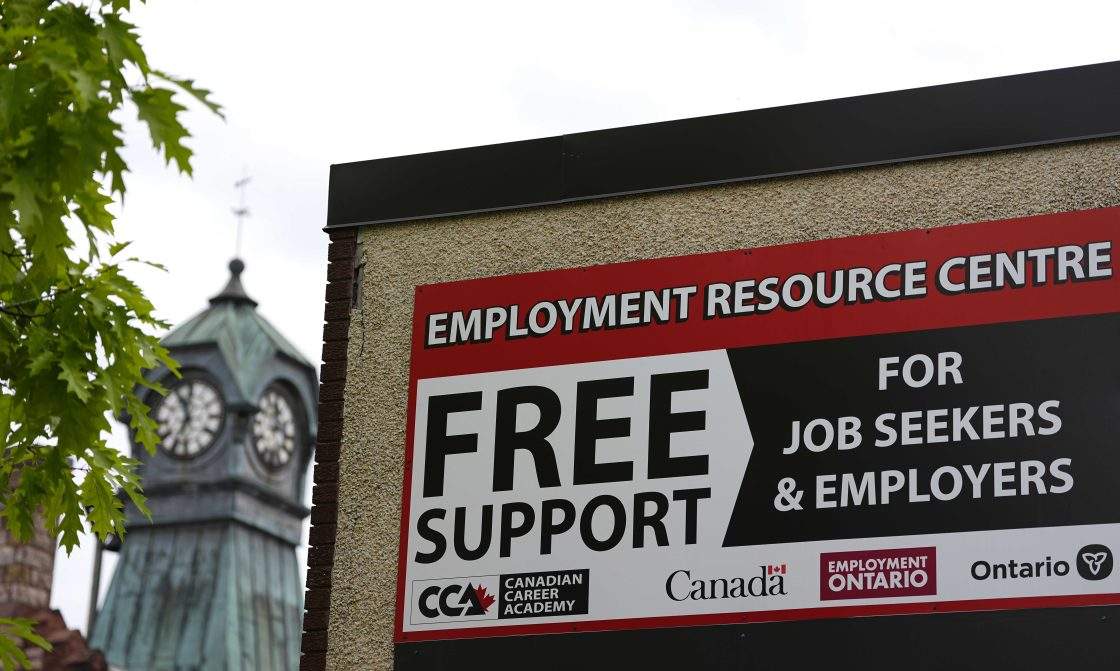
FILE – An employment resource centre is seen in Carleton Place, Ont. on Friday, Aug. 7, 2026.
THE CANADIAN PRESS/Justin Tang
Canada’s unemployment rate increased 0.2 percentage points to 6.7 per cent last month as more people looked for work — especially younger Canadians.

A Reuters poll of economists had expected the economy would bounce back with a gain of 13,600 jobs in October.
Statistics Canada said Friday that Canada’s workforce shed 4,700 jobs in October, with the unemployment rate for youth aged 15-24 rising 0.7 percentage points from September to 13.7 per cent.
Young students found it especially challenging to find work with the unemployment rate at 13.5 per cent compared to 12.3 per cent of young Canadians who were not attending school. Statistics Canada also notes the proportion of youth attending school in October was 63.3 per cent, up from 62.2 per cent a year earlier.
Meanwhile, unemployment was unchanged last month for core-aged working Canadians (25 to 54 years old), Statistics Canada says, at 5.8 per cent for men and 5.3 per cent for women.
Most of the job losses last month were concentrated in retail and wholesale trade, where 29,000 jobs were shed. At the same time, there were increases for construction and educational sectors with 16,000 and 15,000 jobs added each respectively.

Private sector employment fell by 53,000 positions last month, marking the first decline in the segment since February. Employment in the public sector, meanwhile, was up 50,000 positions.

Get breaking National news
StatCan noted that, on a year-over-year basis, private sector jobs are still up while the public sector is down.
Statistics Canada says nearly a quarter, or 23.7 per cent of Canadians who are able and willing to work were considered on long-term unemployment last month, meaning they had been continuously searching for work for 27 weeks or more. That’s up from 21.5 per cent a year earlier.
The job market overall has been struggling amid the trade war with the U.S., and especially in recent months as U.S. tariffs continue to impact Canadian businesses and leave many feeling uncertain about the future and hesitant to hire new workers.
From August through October, Canada’s job market has shed nearly 115,000 jobs, and the unemployment rate has increased from 6.4 in August.
“For anyone hoping that October would bring a recovery in the Canadian job market after back-to-back negative surprises, today’s release is a disappointment,” says economist Sneha Puri at Indeed in a statement.
“There are visible cracks in the labour market, especially for young jobseekers, and if this optimism isn’t then translated into a strong jobs report in the months ahead, the surprising weakness in headline employment will start to look less temporary and more like the beginning of a renewed cooling in the labour market.”

- Budget 2026 proposes 1st deposit insurance limit increase in 2 decades
- Stamp prices are going up for Canadians under Budget 2026
- Carney’s ‘ambitious’ but ‘risky’ budget eyes investment in uncertain world
- Nova Scotia seafood sector welcomes China deal extension, but some exporters feel left out
At the same time, the layoff rate — the share of workers who were laid off between September and October — was little changed last month at 0.7 per cent compared to 0.6 per cent in September.
One economist believes the latest round of U.S. tariffs have not yet led to widespread layoffs.
“New U.S. tariffs implemented since Aug. 22 have not, and are not expected to lead to widespread layoffs in Canada. They are severe but of a narrow scope,” said senior economist Claire Fan at Royal Bank of Canada in a statement.
“Manufacturing jobs changed little in August and September. Sectors disproportionately affected by U.S. tariffs including auto and steel manufacturers can continue to look to increasing government support to transition out of a period of reduced U.S. demand.”
The Bank of Canada increased its benchmark interest rate last month for the first time in three years, and mainly to get ahead of what’s expected to be higher inflation in the coming months.
But if the Canadian job market continues to show signs of stress, that could influence the central bank to hold its key policy rate next month at the last meeting of the year.
“The temporary factors that we expected to flatter today’s data showed up less than we had envisioned, but that doesn’t account entirely for the downside surprise, with underlying labour market dynamics appearing to have weakened again in recent months,” says senior economist Andrew Grantham at CIBC in a statement.
– with files from The Canadian Press
Stick to the Facts
Add Global News as a Preferred Source on Google to see more of our stories in your search results.
Journalistic standards
Comment
Report an error
Sponsored content